

Views: 0 Author: Site Editor Publish Time: 2026-09-20 Origin: Site


Procuring outdoor culinary infrastructure carries significant financial and operational risk. You face constant threats from weather degradation, strict fire safety compliance, and demanding long-term maintenance. Many vendors market aesthetically pleasing units that quickly fail under heavy use or harsh environmental conditions. Buyers often discover structural flaws, poor ergonomic workflows, inadequate ventilation, or voided warranties only after the installation crew leaves the site.
Mitigating these risks requires a rigorous vetting process before signing any purchase order. You must look past the glossy brochures and dig into the engineering specifications. This guide provides a comprehensive framework of technical, logistical, and operational questions to ask any manufacturer before committing to an Outdoor Kitchen. By asking the right questions upfront, you ensure your investment survives the elements, meets local codes, and functions flawlessly for years.
Material composition is non-negotiable: Prioritize marine-grade materials and verify the specific gauge and coating processes used by the aluminum outdoor kitchen manufacturer.
Workflow and ergonomics matter: A successful outdoor kitchen pod must be designed around actual culinary workflows, optimizing the space for how users prep, cook, and entertain.
Compliance dictates viability: Commercial and hospitality deployments require strict adherence to local fire codes, UL-listed electrical components, and certified ventilation systems.
Logistics and scalability impact total cost: Pre-fabricated modularity reduces on-site labor, but buyers must scrutinize global shipping capabilities, volume flexibility, and realistic lead times.
Warranties reveal true durability: A manufacturer’s confidence is reflected in their warranty exclusions; scrutinize the fine print regarding environmental exposure, "lifetime" claims, and commercial usage.
You cannot evaluate a vendor effectively without first establishing your own rigid baseline requirements. Document the expected daily usage volume of your planned culinary space. A unit stationed at a busy resort pool deck faces entirely different operational stresses than a private residential patio setup. Environmental exposure dictates material selection. Coastal salt air, extreme temperature fluctuations, and high UV indexes will destroy inferior materials in a single season. You must also define the aesthetic alignment required to match the existing property architecture.
Budgeting requires looking far beyond the initial hardware purchase. You must account for site preparation, installation labor, utility trenching, and ongoing maintenance. Routing gas lines, upgrading electrical panels, and pouring level concrete foundations require significant resources. Anticipate appliance replacement cycles as well. Even premium grills eventually require new burners or grates. Plan your infrastructure so components can be swapped without tearing down the entire structure.
Identify your deployment scale and volume flexibility early in the planning phase. Differentiate between a single high-end residential unit and a multi-unit rollout for a hospitality brand. Manufacturers often structure their production lines differently based on volume. You need to know if the vendor can handle your specific project scope without compromising quality or extending lead times unreasonably.
Evaluate the physical site for wind loads, sun exposure, and drainage patterns before selecting a layout.
Map out the exact utility runs required from the main building to the proposed installation site.
Determine the maximum weight capacity of the installation surface, especially for rooftop or elevated deck deployments.
Establish a hard timeline for project completion, factoring in potential weather delays during the site preparation phase.
When discussing scale with potential vendors, ask direct questions about their manufacturing capabilities. Do they enforce Minimum Order Quantities (MOQs) for custom designs? How flexible are they with scaling order sizes up or down? Do they offer volume production for phased commercial rollouts? What is the timeline for scaling from a single prototype to full production? Getting these answers early prevents wasted time with vendors who cannot meet your logistical needs.
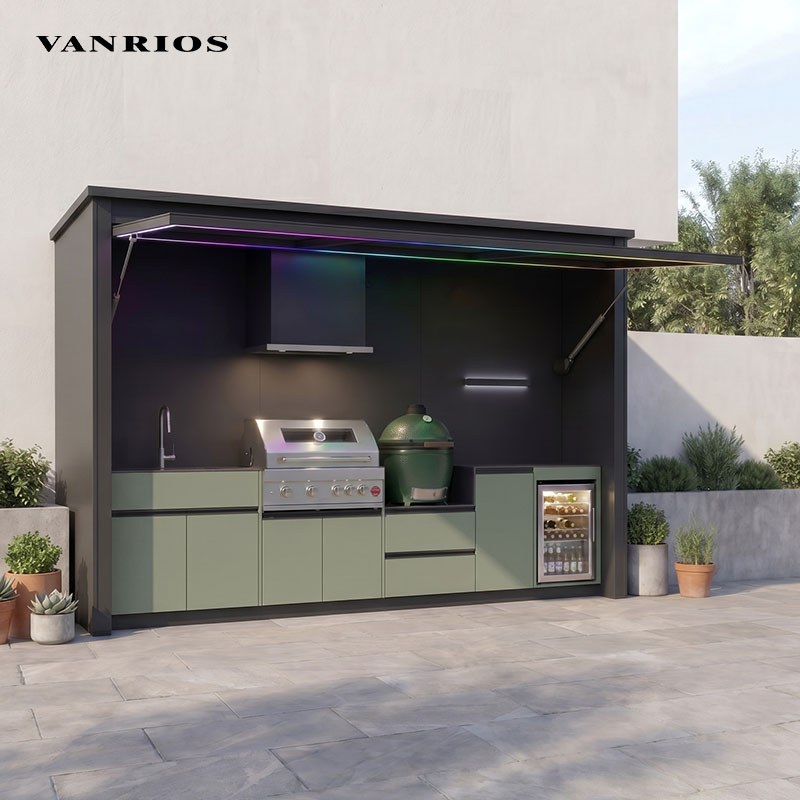
Marketing brochures frequently use the term "weather-resistant." This phrase means very little in actual metallurgical terms. You need to understand the difference between vague marketing claims and actual durability across diverse global climates. Standard steel rusts. Wood rots and warps. Even 304-grade stainless steel will experience "tea staining" when exposed to coastal salt spray or chlorine from nearby swimming pools. You must demand specifics about the exact materials used in the chassis and cabinetry.
When interviewing an aluminum outdoor kitchen manufacturer, drill down into their coating processes. Bare aluminum oxidizes. It requires a high-quality powder coat to survive outdoors. Ask if they use AAMA 2604 or 2605 certified powder coatings, which offer superior UV resistance and color retention. Furthermore, galvanic corrosion occurs when dissimilar metals intersect in a conductive environment, like humid salt air. If a manufacturer uses cheap zinc-plated steel fasteners in an aluminum frame, the fasteners will corrode rapidly, compromising the entire structure. They should use stainless steel fasteners isolated with nylon washers or dielectric grease.
What specific grade of aluminum or stainless steel is used for the chassis and cabinetry?
What is the exact specification of your powder coating process?
How do you mitigate galvanic corrosion where different metals intersect?
Has this unit been field-tested in extreme global climates?
What gauge of metal is used for the primary load-bearing supports?
Metal Type | Common Application | Corrosion Resistance | Weight Profile |
|---|---|---|---|
5052 Marine-Grade Aluminum | Premium Cabinetry & Chassis | Exceptional (with powder coat) | Lightweight |
316L Stainless Steel | Coastal Appliances & Hardware | Very High | Heavy |
304 Stainless Steel | Inland Appliances | Moderate (Prone to tea-staining) | Heavy |
Galvanized Steel | Budget Internal Framing | Low (Rusts when scratched) | Very Heavy |
The horizontal surfaces of your culinary setup take the most abuse. They endure direct sunlight, freezing rain, hot grease, and heavy impacts. Evaluate the thermal shock resistance and porosity of the offered surface materials. Natural stone like granite requires regular sealing to prevent stains from wine or grease. Concrete can crack during freeze-thaw cycles if not properly reinforced with micro-fibers and sealed annually. Sintered stone and premium porcelain offer high UV resistance and zero porosity, making them ideal for harsh environments.
You must also verify the structural support beneath the countertop. A heavy concrete or stone slab requires a robust chassis. If the aluminum framing is too thin, the cabinet will rack under the weight, causing the countertop to crack at its weakest points, usually right behind the grill cutout. Ask the manufacturer about the maximum load-bearing capacity of their standard modules.
Are the countertops rated for direct UV exposure and freeze-thaw cycles without cracking or fading?
What is the load-bearing capacity of the countertop, particularly near appliance cutouts?
Does the surface material require annual chemical sealing?
How is the countertop secured to the chassis to prevent wind uplift in hurricane zones?
A beautiful structure is useless if the chef cannot cook efficiently. Assess how the physical layout supports the functional workflow between prep, cooking, and serving zones. The space must actually work for how users cook and spend time outside. The classic culinary triangle applies outdoors just as it does indoors. The grill, sink, and refrigeration units must be positioned to minimize wasted movement. There must be adequate landing space on both sides of the grill for raw and cooked foods.
Standard counter heights are typically 36 inches, but bar seating areas require 42-inch elevations. Ensure the manufacturer understands these ergonomic standards. A commercial outdoor bbq setup often requires wider walkways behind the counter to accommodate multiple staff members working simultaneously. Trash and recycling receptacles must be integrated seamlessly into the workflow, ideally on pull-out tracks near the primary prep zone.
How does your standard layout optimize the culinary triangle for outdoor cooking?
Can the prep and serving zones be tailored to specific menu requirements?
Are trash and recycling receptacles integrated seamlessly into the workflow?
Do you offer multi-level counter designs to separate the cooking zone from the guest seating area?
Analyze the trade-offs between fully bespoke designs and standardized modular configurations. Bespoke designs offer ultimate flexibility but extend lead times and complicate replacement parts. Standardized modular units ship faster and assemble easily, but they may force you to adapt your space to fit their dimensions. The best manufacturers offer a hybrid approach: standardized internal chassis modules with customizable exterior cladding and appliance cutouts.
Ask how easily the unit can be reconfigured or expanded after the initial installation. If you decide to add a pizza oven or a secondary refrigerator next season, can the existing structure accommodate the addition? Request detailed CAD drawings or BIM objects for architectural integration. This allows your site engineers to plan utility routing with pinpoint accuracy before the unit ever arrives on site.
Housing high-BTU gas or charcoal grills within enclosed structures requires serious engineering. Heat dissipation is critical. If a grill is installed in a combustible frame without proper insulation, it creates a massive fire hazard. Even within non-combustible aluminum or steel frames, excessive heat can warp doors, melt wiring, and destroy adjacent refrigeration units. You must verify the thermal management strategy.
Many manufacturers require the use of insulated grill jackets. These double-walled stainless steel liners create a thermal break between the hot grill and the surrounding cabinetry. Additionally, the island structure itself must be vented. Gas is heavier than air. If a leak occurs, propane will pool at the bottom of the cabinet. Proper cross-ventilation panels are mandatory to allow gas to escape safely.
Do you require the use of proprietary appliances, or can the pod accommodate third-party equipment?
How is the structure engineered to manage heat dissipation?
Are insulated grill jackets mandatory for your specific cabinetry?
Are ventilation panels built into the island to prevent gas pooling?
What is the minimum CFM requirement for overhead ventilation if installed under a covered patio?
Commercial properties face a strict regulatory landscape. Fire marshals will not hesitate to shut down a non-compliant culinary installation. You must adhere to rigid clearances to combustibles. If your unit sits under a pergola, near a wooden fence, or against a building exterior, specific setback distances are legally mandated. These distances vary based on the BTU output of the grill and the materials used in the surrounding structures.
Furthermore, any hospitality bbq pod must often meet ADA (Americans with Disabilities Act) compliance. This requires specific counter heights, usually 34 inches, and accessible reach ranges for appliances. Knee clearance must be provided under sinks and prep areas. Failure to meet these standards exposes the property owner to significant legal liability and potential fines.
Can you provide engineering sign-offs proving the unit meets commercial fire safety standards?
What are the exact clearance requirements from the back and sides of the unit to combustible structures?
Can the cabinetry be configured to meet ADA accessibility guidelines?
Do your designs comply with NFPA 54 (National Fuel Gas Code) regulations?
Examine how the manufacturer handles the internal routing of utilities. Poor utility integration leads to messy, dangerous on-site modifications. Gas lines must be hard-piped with black iron or use approved flexible stainless steel connectors with accessible, clearly marked shut-off valves. Electrical wiring must be protected from heat and moisture. All outlets must be GFCI protected and feature weatherproof in-use covers.
Water lines require proper drainage and winterization capabilities. The best manufacturers engineer dedicated utility chases within the cabinetry. This keeps wires and pipes organized and away from heat sources. Ask if the unit arrives with pre-plumbed gas lines and water manifolds ready for a single-point site connection, or if your local tradesmen will need to route everything through the cabinets on site.
Verify that all internal electrical components are UL-listed for wet locations.
Confirm the exact location of the utility entry points on the manufacturer's shop drawings.
Ensure the design includes accessible access panels for future plumbing or electrical maintenance.
Check local codes regarding the requirement for grease traps on outdoor commercial sinks.
Uncover the realities of manufacturing timelines. Delays in the supply chain can derail your entire project schedule. You need transparency regarding where the materials are sourced and where the final assembly takes place. International shipping introduces customs delays and freight risks. You must understand how the manufacturer protects the unit during transit. A poorly crated cabinet will arrive dented and unusable.
Ask about their crating standards. Do they use ISPM-15 stamped wood for international shipments? Do they utilize shock-absorbing materials inside the crate? You also need to know who handles the freight logistics. Some manufacturers offer door-to-door service, while others simply load the crate onto a truck and leave the customs paperwork and final delivery coordination entirely up to you.
What is the realistic lead time from final design approval to site delivery?
Are your manufacturing facilities domestic or international?
How is the unit crated to prevent transit damage?
Do you handle international freight and customs logistics?
What is your protocol if a unit arrives damaged?
Define the exact responsibilities of the buyer regarding site readiness prior to the arrival of the unit. The manufacturer builds the equipment, but you must prepare the ground. A fully loaded outdoor kitchen pod requires a perfectly level, reinforced concrete pad. Standard requirements usually dictate a 4-inch thick pad poured with 3000 PSI concrete and reinforced with rebar or wire mesh. If the pad is off by half an inch, the doors will not align, and the countertops may crack under stress.
You also need a plan for moving the unit from the delivery truck to the final location. LTL freight drivers will drop the crate at the curb. They will not move it to your backyard or pool deck. You must coordinate the necessary lifting equipment. Determine if you need a forklift, a pallet jack, or even a crane for elevated installations. Check if the chassis includes adjustable leveling legs to accommodate minor slope variations in the concrete pad.
Site Prep Requirement | Standard Specification | Consequence of Failure |
|---|---|---|
Concrete Foundation | 4-inch thick, 3000 PSI, level within 1/4 inch over 10 feet | Cabinet racking, cracked countertops, misaligned doors |
Gas Supply | Dedicated line sized for total BTU output, accessible shut-off | Low flame height, code violations, fire hazards |
Electrical Supply | Dedicated 20-amp GFCI circuits, weatherproof conduit | Tripped breakers, electrical shorts, safety hazards |
Access Pathway | Clear path minimum 48 inches wide for pallet jack/forklift | Inability to move unit from curb to installation site |
Understand the ongoing operational requirements to keep the unit functional and aesthetically pleasing. No outdoor structure is entirely maintenance-free. Hinges require lubrication with PTFE or silicone sprays. Surfaces require cleaning with specific non-abrasive agents. Gas burners need periodic clearing of debris, spider webs, and grease buildup. You need to know exactly what the manufacturer expects you to do to maintain the equipment.
Furthermore, moving parts eventually fail. Gas struts that hold up heavy access doors will lose pressure over time. Drawer slides exposed to grit and moisture will eventually stick. You must ensure replacement parts are standardized and easily sourced. If the manufacturer uses proprietary hinges that are discontinued two years from now, you will be forced to replace entire doors instead of a ten-dollar piece of hardware.
What is the recommended maintenance schedule for the chassis, hinges, and surfaces?
Are replacement parts standardized and easily sourced?
What specific cleaning chemicals are approved or forbidden for use on the finishes?
Do you provide a comprehensive maintenance manual with the unit?
Read the fine print of the warranty documents. Marketing materials love to tout "lifetime" guarantees, but the actual warranty document often contains massive loopholes. Many warranties explicitly exclude commercial usage, limiting coverage strictly to residential applications. If you install a residential unit at a hotel, the warranty is void the moment it is powered on.
Environmental factors frequently void structural warranties. If you install the unit within one mile of a saltwater coast or immediately adjacent to a chlorinated pool, the warranty might be instantly voided unless you purchased a specific marine-grade upgrade. Pay close attention to labor clauses. Most warranties cover the cost of the replacement part but explicitly exclude the cost of the labor required to install it.
Verify if the warranty covers commercial usage or is strictly limited to residential applications.
Identify specific environmental factors that explicitly void the structural warranty.
Check if the warranty covers the cost of labor for repairs, or only the replacement parts.
Compare the warranty duration on moving parts like drawer slides against the main chassis.
Understand the formal process for filing a warranty claim and the required documentation.
Selecting a manufacturer requires prioritizing engineering transparency, material science, ergonomic workflow, and logistical support over mere aesthetics. A beautiful facade often hides structural flaws that will cost you heavily in repairs and replacements. Eliminate vendors who cannot provide clear answers on material gauges, thermal management, scalability, or commercial compliance. Prioritize manufacturers who offer detailed spec sheets, transparent warranties, and proven case studies in similar environments.
Take the following actionable steps to secure the right vendor:
Request a comprehensive technical specification packet for the exact model you intend to purchase.
Ask for references and photos from past commercial or high-end residential installations in climates similar to yours.
Schedule a site-readiness consultation with your shortlisted vendors to verify utility routing and foundation tolerances.
Demand a written copy of the warranty and highlight any environmental exclusions before signing the contract.
A: Lifespan depends heavily on materials. Marine-grade aluminum or 316L stainless steel can last 15-20+ years under heavy use. Inferior materials may degrade in 3-5 years under commercial stress. Always verify "lifetime" claims against the actual warranty fine print and environmental exclusions.
A: Heavy-gauge, powder-coated aluminum offers superior rust resistance and lighter weight for elevated installations like rooftop decks. Crucially, it eliminates the "tea-staining" surface rust common with lower-grade stainless steel when exposed to salt air or pool chemicals.
A: Yes, in almost all cases. While the pod itself may be pre-fabricated, the utility connections (gas, electric, plumbing) and the structural placement almost always require local municipal permits, zoning approvals, and safety inspections.
A: Yes. Reputable manufacturers offer extensive customization. This includes brand-specific RAL powder coat colors, custom architectural cladding, and tailored appliance layouts designed to match specific culinary workflows and menu requirements.
A: Standard procedures include shutting off and bleeding all water lines to prevent pipe bursts. You must disconnect power to non-essential appliances, clean all surfaces thoroughly to remove acidic food residue, and utilize manufacturer-approved, breathable weather covers.


