

Views: 0 Author: Site Editor Publish Time: 2026-09-18 Origin: Site


Outdoor cooking structures face a brutal reality. Build them without climate-specific engineering, and they fail. Exposure to moisture, aggressive UV radiation, and relentless freeze-thaw cycles degrades poorly specified materials within a single season. Buyers navigate conflicting requirements. You want stunning aesthetic design. You must meet strict fire safety codes. You also need aggressive weatherproofing. Balancing these needs without over-engineering the project requires a clear strategy. You cannot rely on guesswork when combining high-heat appliances with driving rain and freezing temperatures. This guide provides a technical evaluation framework for designing, specifying, or purchasing an outdoor BBQ pod. We focus heavily on structural integrity, material science, and safety compliance. You will learn exactly how to block water ingress, manage heat dissipation, and build a structure that survives the elements year after year.
Material Selection is Binary: Structural longevity depends entirely on non-combustible, moisture-impervious framing (e.g., galvanized steel, aluminum, or specialized composite panels) rather than traditional untreated timber.
Water Ingress Occurs at the Seams: A truly waterproof outdoor kitchen shed relies on architectural flashing, proper drainage planes, and marine-grade sealants at every appliance cutout.
Fire Safety Dictates Design: Integrating high-heat appliances requires strict adherence to clearance zones, insulated grill jackets, and active ventilation to maintain a compliant fire rated kitchen.
Utility Protection is Non-Negotiable: Electrical and plumbing systems demand IP-rated enclosures and winterization protocols to survive extreme temperature fluctuations.
Outdoor structures face constant environmental attacks. Moisture and humidity act as silent destroyers. Standard cabinetry materials absorb ambient moisture rapidly. This absorption leads directly to wood rot, toxic mold growth, and the delamination of veneers. Once moisture penetrates the core, structural failure becomes inevitable. We see this constantly on job sites where builders use indoor-grade MDF or standard plywood for exterior applications.
Thermal expansion and contraction pose another massive threat. Freeze-thaw cycles wreak havoc on rigid frameworks. Water enters micro-cracks during the day. At night, it freezes and expands. This expansion causes mortar cracking, joint separation, and severe structural warping. Your framework must accommodate these microscopic shifts without breaking. Rigid materials without expansion joints will tear themselves apart over a single harsh winter.
UV degradation rounds out the threat matrix. Prolonged sun exposure destroys low-grade materials. Plastics suffer from chalking and embrittlement. Cheap composites fade and lose their structural elasticity. UV rays break down the molecular bonds in sealants, turning flexible barriers into brittle, useless crusts. You must specify UV-stabilized polymers and marine-grade finishes to combat solar radiation.
Your physical footprint dictates your weather resilience. Straight-line, L-shape, and U-shape layouts interact differently with prevailing weather patterns. A straight-line layout offers minimal wind protection. A U-shape design can create a sheltered microclimate for the chef, blocking crosswinds effectively. You must analyze the specific site conditions before pouring the foundation.
Strategic positioning changes everything. You must orient the pod to naturally block wind-driven rain. Place the solid back wall against the prevailing storm trajectory. This orientation ensures the primary cooking surface and prep space remain functional during inclement weather. It also prevents sudden wind gusts from extinguishing gas burner flames or blowing smoke directly into your seating area.
Identify the prevailing wind direction during your primary cooking seasons.
Map the trajectory of afternoon sun exposure to position shade structures effectively.
Locate natural drainage slopes to ensure water flows away from the pod foundation.
Determine the optimal placement for the solid windbreak wall.
Many builders still push treated lumber for outdoor builds. They compare outdoor setups to indoor kitchens. This comparison is dangerously flawed. Indoor kitchens safely utilize combustible wood cabinetry because the environment is controlled. Outdoor environments introduce wild, uncontrolled variables. You cannot treat an outdoor space like a living room.
Wind-driven flare-ups happen instantly. Outdoor grills often lack immediate, constant supervision. Rapid moisture degradation compromises fire-retardant coatings on timber. The baseline requirement is absolute: your core materials must simultaneously resist ignition and repel water. There is no room for compromise on this standard. Using combustible framing near high-BTU gas burners invites disaster.
Composite panel systems represent the modern standard. These panels typically feature a structural foam core sandwiched between cementitious or fiberglass skins. They offer an incredible strength-to-weight ratio. They also provide superior thermal resistance, which protects adjacent storage from grill heat. These panels do not absorb water, making them inherently weatherproof. They assemble quickly and provide a perfectly plumb surface for cladding.
Traditional timber framing carries massive risks. Wood is highly susceptible to termite damage and fungal rot. To survive outdoors, timber requires extensive chemical treatments. When exposed to the intense ambient heat of a grill, these chemicals can off-gas toxic fumes. Timber also warps as humidity fluctuates, which eventually cracks your exterior stucco or stone veneer. We refuse to use timber framing for any masonry-clad outdoor structure.
Metal framing eliminates the rot factor entirely. Galvanized steel provides immense load-bearing capacity. You need this strength if you plan to use heavy masonry finishes or install solid-fuel pizza ovens. However, steel requires thick zinc coatings to prevent rust. Any cut or weld must be treated with cold galvanizing compound immediately. Leaving raw steel edges exposed guarantees rapid oxidation.
Aluminum framing dominates coastal installations. It boasts natural corrosion resistance. It will not rust, even when exposed to heavy salt spray. Building an all-weather BBQ island with aluminum guarantees structural longevity. The material remains lightweight yet structurally rigid, making it ideal for modular installations on existing decks or patios.
You must manage implementation risks. Galvanic corrosion occurs when dissimilar metals interact in damp environments. If you use aluminum framing, you cannot use standard steel fasteners. You must use isolated stainless steel fasteners or specialized barrier tapes to prevent the metals from reacting and degrading each other.
Framing Material | Load-Bearing Capacity | Corrosion Resistance | Combustibility |
|---|---|---|---|
Treated Timber | Moderate | Low (Prone to rot) | High (Combustible) |
Galvanized Steel | Very High | Moderate (Requires zinc coating) | Zero (Non-combustible) |
6061 Aluminum | High | Excellent (Natural oxidation barrier) | Zero (Non-combustible) |
Composite Panels | High | Absolute (Zero absorption) | Zero (Fire-rated skins) |
Your foundation dictates the lifespan of the structure above it. A reinforced concrete slab or heavily fortified decking foundation is mandatory. The ground must be perfectly level and pitched slightly away from the structure to facilitate rapid water runoff. Standing water destroys foundations. Frost heave will crack a poorly reinforced slab, taking your masonry finishes down with it.
Moisture barriers are critical. You must install capillary breaks between the foundation and the base track of your framing. Sill gaskets prevent ground moisture from wicking up into the structure. If you skip this step, moisture will climb the walls, trapped behind your beautiful exterior cladding, rotting the system from the inside out.
Excavate the site below the local frost line for footings.
Compact a minimum of four inches of crushed gravel for drainage.
Pour a steel-reinforced concrete slab with a 1% pitch for water runoff.
Apply a liquid-applied waterproofing membrane over the cured concrete.
Install closed-cell foam sill gaskets under all base tracks.
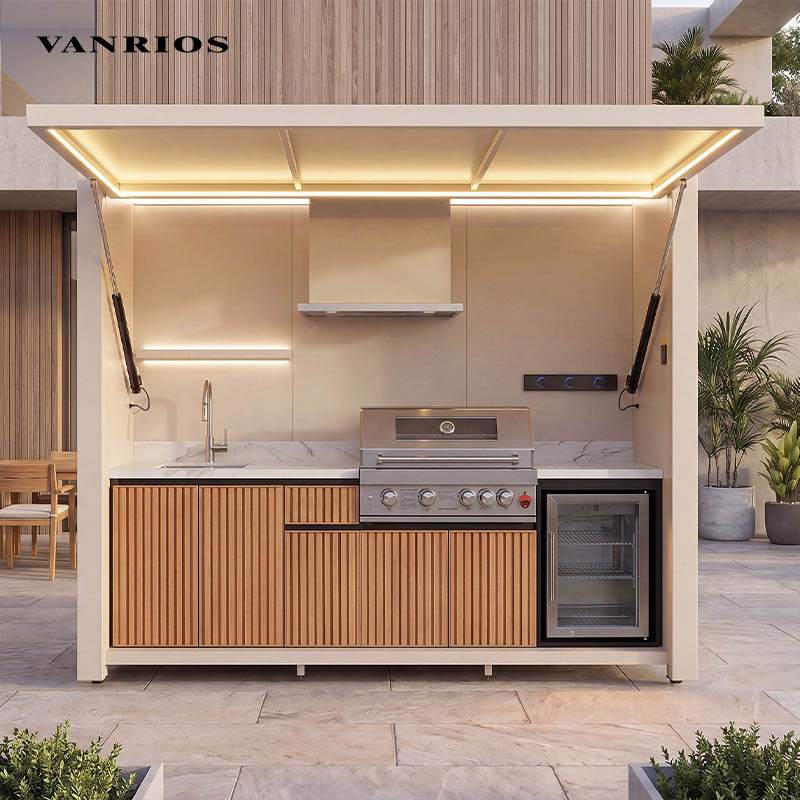
Choosing the right skin for your structure determines its weather resilience. Cementitious backer boards provide a highly stable, water-resistant substrate. They are the ideal backing for heavy stone veneer or traditional stucco. Unlike drywall, cement board will not disintegrate when wet. You must tape the seams with alkali-resistant fiberglass mesh and coat them with thinset mortar.
High-Density Polyethylene (HDPE) and marine-grade polymers offer a different approach. These solid polymer panels deliver extreme UV stability. They boast zero moisture absorption. They will never swell, rot, or require painting. They are perfect for modern, sleek designs. You can hose them down directly without worrying about water penetration.
Stainless steel remains a popular choice for cabinetry and cladding. You must understand the metallurgy. Standard 304 stainless steel works for most inland applications. Marine-grade 316 stainless steel contains molybdenum, drastically increasing its pitting resistance. If you live near the ocean or a saltwater pool, 316 is mandatory for a waterproof outdoor kitchen shed. I have seen 304 stainless pit and rust within a month of exposure to coastal salt spray.
Waterproof materials mean nothing without proper water management. Water-shedding countertops are your first line of defense. Countertops must feature adequate overhangs and machined drip edges. These edges force water to drop straight down to the patio rather than curling back under the counter and running down the cabinet faces. A minimum overhang of 1.5 inches is standard field practice.
Sealants bridge the gaps. You must use silicone-based, high-temperature sealants around every appliance cutout. Sinks, drop-in coolers, and side burners require continuous, unbroken beads of marine-grade silicone. Standard latex caulking will melt under grill heat or crack during the first winter freeze. Apply the sealant generously and tool it smooth to prevent water pooling.
Internal water management is just as vital. Condensation will form inside the pod cavity. You must integrate weep holes at the lowest points of the structure. Internal drainage planes allow trapped moisture to escape harmlessly. A hermetically sealed box will trap humid air, leading to internal corrosion and stagnant odors.
Building codes strictly regulate high-heat appliances in covered or semi-enclosed spaces. You cannot simply drop a massive gas grill into a tight enclosure. Local municipalities mandate specific non-combustible zones. A compliant fire rated kitchen requires meticulous planning and adherence to structural safety standards. Inspectors will fail your build if you violate clearance codes.
Insulated grill jackets are often mandatory. If you mount appliances into potentially combustible or heat-sensitive frameworks, the jacket acts as a thermal barrier. It prevents the intense heat of the firebox from transferring to the surrounding structure. Even with metal framing, jackets protect exterior finishes from heat discoloration. The jacket creates a dead-air space that dissipates extreme temperatures safely.
Clearance-to-combustible specifications are non-negotiable. Appliance manufacturers provide exact measurements for safe operation. You must maintain these air gaps. Failure to respect these clearances voids the appliance warranty and creates a severe fire hazard. Always design your cutouts based on the manufacturer's engineering schematics, not rough estimates.
Housing diverse equipment within a single pod creates complex engineering challenges. A drop-in gas grill, a heavy dome pizza oven, and an outdoor fridge all have conflicting needs. You must isolate the heat zones from the cooling zones. Never place a refrigerator directly beneath a gas grill firebox. The radiant heat will force the compressor to run continuously, leading to premature failure.
Refrigeration requires specific environmental controls. Compressors need breathable venting to prevent overheating. However, these vents must simultaneously block water ingress. Louvered vent panels with internal rain baffles solve this problem. Heavy solid-fuel ovens require heavily reinforced structural support and distinct, expanded fire-rated clearances due to their extreme radiant heat. You must build a dedicated masonry base for any dome oven.
Airflow dynamics dictate safety. You must engineer cross-ventilation to prevent gas pooling. Propane is heavier than air; it sinks and pools at the bottom of enclosures. Natural gas is lighter than air; it rises. You must place ventilation panels at both the top and bottom of the structure to purge any accidental gas leaks safely. A minimum of 10 square inches of ventilation per side is a standard baseline.
Mechanical exhaust hoods are often required. If your pod sits under a pergola, a solid roof structure, or a lanai, smoke management is critical. High-CFM outdoor exhaust hoods capture grease and smoke before they stain your ceiling or choke your guests. The ductwork must be double-walled and routed safely away from combustible roof materials.
Calculate the total BTU output of all cooking appliances to size the exhaust fan correctly.
Install the hood at the manufacturer-specified height above the cooking surface.
Use rigid, smooth-walled ductwork to prevent grease accumulation in the exhaust run.
Terminate the exhaust run with a weatherproof roof cap equipped with a backdraft damper.
Utilities fail quickly when exposed to the elements. Electrical systems demand rigorous protection. You must specify GFCI (Ground Fault Circuit Interrupter) outlets exclusively. Every outlet requires a weatherproof in-use cover, commonly known as a bubble cover. All wiring must run through UV-resistant, watertight conduit. Never use indoor-grade Romex wire for outdoor island runs.
Plumbing requires strict winterization protocols. Freezing water expands and shatters pipes. Design the system with gravity-drained lines. Install primary shut-off valves inside the climate-controlled primary residence. Use frost-proof yard hydrants for water supply lines. Before the first freeze, you must isolate the outdoor lines and drain them completely. We recommend installing an air compressor blowout valve to clear residual water from the lines.
Utility Component | Protection Standard | Field Application Notes |
|---|---|---|
Electrical Outlets | GFCI + IP66 In-Use Cover | Must remain sealed even with a cord plugged in. |
Wiring Conduit | Schedule 40 PVC or Liquidtight | Bury underground runs below the frost line. |
Water Supply Lines | PEX or Type L Copper | Insulate all exposed lines; pitch for gravity drain. |
Drainage Pipes | Schedule 40 PVC | Install cleanouts for easy access; avoid complex traps. |
Dry storage keeps your outdoor space functional. Standard cabinet doors let bugs and water inside. You must evaluate cabinetry that features thick rubberized gaskets on all doors and drawers. These gaskets compress when closed, creating a sealed, weather-tight micro-environment for your dry goods. Without gaskets, humidity will ruin your stored items.
Built-in, weather-tight storage is essential. You need dedicated spaces to keep cooking essentials organized. Utensils, charcoal bags, and smoking wood must remain dry and clutter-free year-round. Damp charcoal is useless. Properly sealed drawers protect your fuel and tools from ambient humidity. We install deep, fully enclosed drawer boxes specifically for heavy charcoal bags.
Hardware is a common failure point. Standard hinges and drawer slides seize up from rust within months. We recommend heavy-duty, soft-close stainless steel hardware. Look for marine-grade components that resist seizing. Regular lubrication with a dry Teflon spray ensures smooth operation despite constant weather exposure. Avoid grease-based lubricants, as they attract dust and grit.
Evaluating materials requires looking past the initial installation. Fast-degrading materials demand constant upkeep. Staining wood, replacing rusted hinges, and patching cracked stucco consume your weekends. Zero-maintenance materials eliminate this labor. A well-built outdoor kitchen shed should serve you, not create weekend chores. You want to spend your time cooking, not repairing.
Consider the realities of rebuilding. A timber-framed island often requires a complete teardown after five to seven years of harsh weather exposure. Rot compromises the frame, making it unsafe to support heavy grills. Conversely, an aluminum-framed, composite-clad pod offers a lifetime of structural stability. The maintenance effort drops to simple surface cleaning with mild soap and water.
Manufacturer warranties contain strict clauses. You must read the fine print for outdoor appliances. Many manufacturers void warranties if the unit is installed without proper weather protection or adequate ventilation. Installing an indoor-rated fridge outdoors immediately voids the coverage. Always specify outdoor-rated, UL-listed appliances designed specifically for exterior temperature fluctuations.
Scalability adds long-term value. Modular BBQ pods allow you to build in phases. You can start with a grill and prep space. Later, you can add refrigeration, sinks, or pizza ovens. Modular systems allow these additions without compromising the original weatherproofing. The structural connections remain sealed and secure as the footprint expands. You bolt the new modules directly to the existing frame using factory-machined mounting points.
Audit your proposed installation site immediately to determine prevailing wind direction and natural water drainage paths.
Consult your local municipal building codes to verify exact fire clearances and exhaust hood requirements for covered structures.
Request detailed material specification sheets from pod manufacturers to confirm the use of non-combustible, zero-absorption framing.
Map out your utility runs and establish a clear, accessible winterization plan for all plumbing lines.
A: No. Treated lumber still warps and twists as temperatures fluctuate. The intense radiant heat from built-in grills can cause the chemical treatments in the wood to off-gas. Always use non-combustible materials like aluminum, galvanized steel, or composite panels for the structural frame.
A: If your grill is mounted into a structure containing any combustible materials, a jacket is mandatory. Even with metal framing, a jacket is highly recommended to prevent extreme heat transfer from discoloring exterior finishes like stucco or cracking stone veneers.
A: Ensure your countertops are installed with a microscopic pitch to shed water away from the cooking area. Countertops must feature an overhang with a machined drip edge underneath to force water to drop to the floor, bypassing the cabinet faces.
A: You must design the system to be easily drained. Install a master shut-off valve inside the heated footprint of your home. Before freezing temperatures arrive, shut off the water supply, open the outdoor taps, and allow gravity to drain the lines completely.
A: Yes, standard 304 stainless steel can develop surface rust, often called tea staining, especially in humid or coastal environments. For maximum corrosion resistance near saltwater pools or the ocean, specify marine-grade 316 stainless steel for all hardware and cabinetry.
A: Standard cabinet doors will not work. You must install fully enclosed, weather-tight storage units. Look for doors and drawers equipped with thick, continuous rubberized gaskets that compress when closed, creating a sealed micro-environment.


