

Views: 0 Author: Site Editor Publish Time: 2026-08-31 Origin: Site


Upgrading from standard patio seating to an outdoor daybed transforms a basic backyard into a resort-grade retreat. It stands as a significant upgrade to your exterior living space. Unfortunately, buyers often prioritize aesthetics over structural longevity. You might purchase a visually stunning piece, only to face premature rust months later. Faded fabrics and spatial crowding quickly ruin the relaxing experience. Nobody wants to navigate cramped walkways or sit on soggy cushions. This guide provides a rigorous evaluation framework to prevent those exact frustrations. We help you assess materials, spatial requirements, and performance features thoroughly. You will learn exactly how to balance visual appeal against harsh environmental realities. Applying these insights ensures your new sanctuary withstands the elements beautifully. Reading this guide thoroughly guarantees your investment delivers daily comfort and long-term reliability.
Material dictates lifespan: Frame composition is the biggest predictor of longevity; an outdoor aluminum daybed offers the highest durability-to-maintenance ratio.
Space planning requires 360-degree thinking: Factoring in canopy clearance, modular separation, and walking paths is critical to avoiding a cramped patio.
Fabric and foam are non-negotiable: UV-resistant acrylics and quick-dry foams are mandatory for real-world weather exposure, not just optional upgrades.
Maintenance realities matter: Natural materials require annual sealing, whereas metal composites prioritize ease of ownership.
Buying oversized patio furniture requires exact measurements and honest lifestyle assessments. Many homeowners buy beautiful pieces online, only to find they dominate the deck entirely. Avoiding this requires understanding your available footprint and your true daily habits.
You must calculate the "active footprint" of your furniture. This metric encompasses much more than the static dimensions of the frame. The active footprint includes the space required to deploy retractable canopies fully. It also accounts for extending modular ottomans during large gatherings. We strongly recommend maintaining a strict three-foot walking clearance around the entire perimeter. This buffer prevents your patio from feeling cluttered.
Measure your vertical constraints carefully. Look for overhanging tree branches, low porch ceilings, or hanging light fixtures. These overhead obstacles dictate canopy compatibility. A tall shade structure needs vertical clearance to operate smoothly. Failure to measure vertical space often results in torn fabrics or jammed canopy mechanisms.
Best Practices for Spatial Measurement:
Use painter's tape to map the static dimensions directly on your deck.
Add an extra 36 inches around the taped area to visualize the walking path.
Measure upward from the taped square to check vertical limits.
Simulate pulling out modular pieces to see if they block stairways or doors.
How you intend to use the furniture dictates the materials and design you need. Let us examine three primary scenarios.
Poolside Lounging: Placing furniture near water demands specific performance traits. You must prioritize quick-dry materials to handle wet swimsuits. Rust-proof frames are absolutely mandatory in these high-moisture zones. Splashing chlorine or saltwater destroys inferior metals rapidly.
Social Entertaining: Hosting guests requires flexibility. Favor modular designs over fixed, single-piece structures. Modular units separate into individual seats and a center coffee table. This adaptability turns a solitary lounging spot into an interactive conversation pit.
Shaded Napping and Reading: Direct sunlight makes reading difficult and napping uncomfortable. If relaxation is your goal, prioritize models featuring integrated canopies. Look for fabrics bearing a high UPF rating to block harsh rays. High-density foam cushions provide the necessary support for extended afternoon resting.
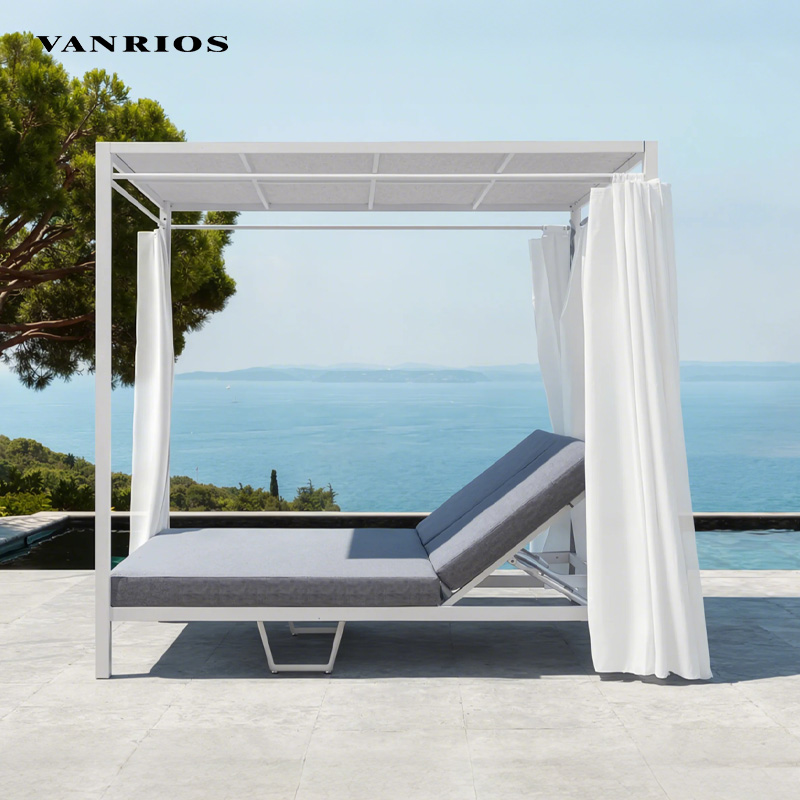
Frame composition represents the most critical factor in exterior furniture longevity. The underlying skeleton dictates how the piece handles moisture, wind, and daily wear.
Industry experts consistently recognize the outdoor aluminum daybed as the standard for high-end exterior living. This material strikes a perfect balance between strength and practicality. Aluminum offers several core advantages for homeowners.
First, aluminum is naturally rust-proof. It forms a protective oxide layer upon exposure to the air. This chemical reaction stops corrosion before it starts. Second, it remains incredibly lightweight. You can reposition the furniture easily to chase the sun or clean the deck underneath. Third, aluminum shows high resistance to salt air. This trait makes it ideal for coastal climates where ocean breezes destroy lesser metals. Ultimately, you should view the Aluminum Daybed as the benchmark for a zero-maintenance, high-longevity investment.
Other materials offer distinct visual styles but carry significant maintenance burdens. Understanding these trade-offs prevents buyer's remorse.
Teak and Hardwoods: Wood offers a premium organic aesthetic. It blends beautifully into natural garden settings. However, teak requires strict annual sanding and oiling. Skipping this maintenance causes the wood to silver, splinter, and eventually rot. It demands significant manual labor to keep it looking new.
Wicker and Rattan: Traditional natural wicker belongs indoors. Outdoor applications require high-density polyethylene (HDPE) synthetic resin. True HDPE survives intense UV exposure without cracking or peeling. Cheaper PVC alternatives unravel and snap after a single summer in the sun.
Steel and Wrought Iron: Iron provides immense structural durability and a classic look. However, it remains highly susceptible to rust. If the protective powder coating chips, moisture attacks the exposed metal immediately. Furthermore, these metals are extremely heavy. Moving a wrought iron piece requires multiple people and risks scratching your patio tiles.
Frame Material Comparison Chart
Material Type | Rust Resistance Level | Weight / Mobility | Maintenance Frequency |
|---|---|---|---|
Aluminum | Excellent (Naturally Rust-Proof) | Lightweight / Easy to Move | Minimal (Basic Washing) |
Teak / Hardwood | Moderate (Can Rot) | Heavy / Hard to Move | High (Annual Sanding & Oiling) |
HDPE Wicker | Excellent (No Metal Frame Exposed) | Medium / Manageable | Low (Wipe Down Required) |
Steel / Iron | Poor (Rusts if Scratched) | Very Heavy / Immobile | Moderate (Touch-up Paint Needed) |
Beyond the frame, the soft components and mechanical features determine your daily comfort. Poor quality fabrics and flimsy canopies ruin the experience rapidly.
You must evaluate fabric grades critically. Standard polyester fades quickly and traps moisture. You should demand solution-dyed acrylics for any serious investment. Brands like Sunbrella inject color into the fibers during production, rather than dyeing the surface later. This process guarantees exceptional color retention. Look for a minimum rating of 1,500 UV hours of colorfastness to prevent sun bleaching.
Foam density matters just as much as the cover. Standard indoor foam acts like a sponge, absorbing rain and breeding mold. You need open-cell, reticulated foam. This specific architecture allows water to drain straight through the cushion. It dries rapidly, preventing mildew growth and keeping your seating sanitary.
Many units feature integrated canopies, but their mechanics vary wildly. You must assess the lifting mechanisms carefully. High-end models utilize gas struts. These hydraulic arms make raising and lowering the shade effortless. Cheaper models rely on manual locking pins. Pins frequently jam, pinch fingers, and wear out over time.
Consider wind resistance carefully. Fixed shades act like sails during heavy storms. They catch gusts and can flip the entire unit over. Collapsible shades offer superior safety. You can fold them flat when wind speeds increase, protecting both the fabric and the frame from storm damage.
Ergonomics transform a basic cushion into a true relaxation zone. Evaluate multi-piece designs for versatility. A great design transforms from a single oversized lounger into a conversational seating pit easily. You pull the pieces apart to create individual chairs around a central table.
Look for adjustable backrests. Fixed flat beds limit your activities. Adjustable ratcheting backs accommodate both flat sleeping and upright reading. This adjustability ensures the piece serves multiple purposes throughout the day.
Common Mistakes in Feature Selection:
Buying dark fabrics in hot climates, causing the seats to burn your skin.
Ignoring zipper quality; cheap zippers rust shut after one rainy season.
Assuming all "outdoor fabric" is solution-dyed. Read the spec sheet carefully.
Owning large patio furniture requires practical foresight. Understanding the cleaning demands and winter logistics helps you protect the piece year-round.
Different materials demand vastly different cleaning routines. Contrast the wipe-down simplicity of an aluminum frame against the high-touch maintenance of wood. Aluminum only requires a mild soap solution and a garden hose. You can clean it thoroughly in ten minutes. Wood requires scrubbing, drying, and applying specialized sealants to prevent deterioration.
Identify the washing requirements for the cushion covers before purchasing. Removable, machine-washable covers serve as a baseline requirement. Spot-cleaning permanently attached covers proves nearly impossible over time. Sunscreen, spilled wine, and bird droppings require aggressive laundering. Zippers allow you to strip the covers off and wash them properly.
Winter weather destroys unprotected furniture. You must establish the necessity of custom-fit, waterproof covers. Even highly durable materials degrade under continuous snow and freezing rain. Generic tarps flap in the wind, let moisture in, and look terrible. Invest in heavy-duty covers tailored to your specific model.
Discuss cushion storage solutions proactively. Leaving cushions outdoors during winter invites disaster. Rodents love nesting inside soft foam during cold months. Extreme moisture freezing inside the foam breaks down the cellular structure. You should utilize waterproof deck boxes or dedicate indoor storage space for the cushions. Protecting the soft components extends their life by years.
Narrowing down your options requires looking past marketing photos. You must verify the structural engineering, review the fine print, and plan for the physical delivery.
Never guess the weight limits. You must verify the static weight capacity clearly listed by the manufacturer. Target a minimum of 500+ lbs for any multi-person unit. A lower limit indicates thin tubing and weak joints. Inspect the weld quality on metal frames if viewing in person. Smooth, continuous welds indicate high-quality manufacturing. Spotty or cracked welds signal impending failure.
Read the warranty details thoroughly. A trustworthy manufacturer will separate the warranty by component. No single material ages at the exact same rate. Look for 5 to 10 years of coverage on an aluminum frame. Expect 3 to 5 years of coverage on solution-dyed fabric. Avoid companies offering a vague "one year total warranty." Short warranties imply the manufacturer lacks confidence in their own engineering.
Daybeds qualify as oversized freight. They do not ship in standard small boxes. Factor in white-glove delivery costs versus flat-pack DIY assembly time. White-glove service brings the fully assembled piece directly to your patio, removing all trash. Flat-pack delivery saves money but requires significant manual labor. Assembling large aluminum frames demands proper tools, patience, and usually two sets of hands. Do not underestimate the effort required to build a massive piece of furniture.
Selecting the right outdoor daybed requires balancing your aesthetic vision against harsh environmental realities. You must look beyond beautiful showroom staging and evaluate the underlying engineering. Proper spatial planning prevents layout regrets, while rigorous material selection guarantees longevity. For the vast majority of buyers looking for a true "buy it for life" solution, an outdoor aluminum daybed paired with solution-dyed acrylic cushions offers the most reliable return on investment. This combination provides supreme comfort without the exhaustive maintenance demands of natural materials. We prompt you to measure your space precisely today. Define your primary use cases, assess your local climate, and explore our curated collection of weather-tested daybeds to find your exact match.
A: The frame (especially if it is an outdoor aluminum daybed) can handle the rain perfectly. However, while outdoor cushions are water-resistant, leaving them in continuous, heavy rain without a cover will eventually lead to saturation. Always use a fitted cover during storms.
A: Lightweight materials like aluminum are incredibly durable but can shift in extreme winds. To mitigate this, keep canopies retracted when not in use, secure the furniture with heavy-duty covers, or opt for designs with weighted bases.
A: Most round daybeds range from 60 to 75 inches in diameter. Rectangular models typically mimic standard twin or full-size mattress dimensions. Always allow an extra 24 to 36 inches around the perimeter for easy access and canopy deployment.


